
Publications / Briefing International
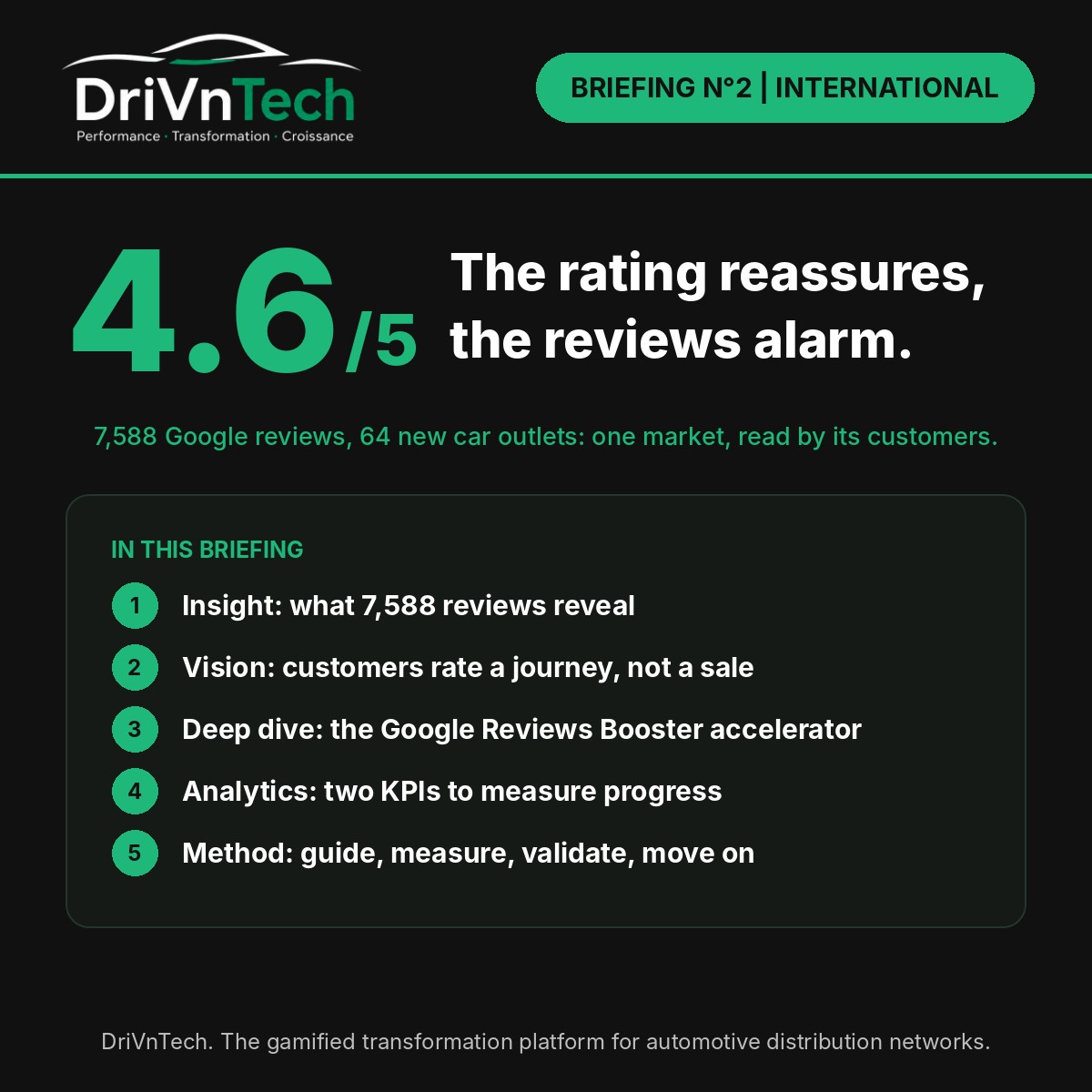
4.6 out of 5. The rating reassures, the reviews alarm.
In this briefing
The second international edition puts the first briefing's claim to the test on a complete area: 7,588 Google reviews on the 64 new car outlets of the Hérault region, in the South of France, over twelve months. The average rating is 4.6 out of 5, yet 8 outlets are falling behind and, over the last quarter, the share of negative reviews rose from 10 to 13 percent.
Customers rate a journey, not a sale: welcome and advice collect 94 percent positive reviews, while follow up and trade in fall below one in two. The example is French, the method is not: it works wherever customers leave public reviews.
The deep dive presents the Google Reviews Booster accelerator, in the Acquisition pillar, built on three levers: volume, response and exploitation. Two KPIs drive it, the request rate and the review to lead rate.
Key takeaways
- A good overall rating can hide a trend that has already turned.
- The showroom is polished, the rest of the journey is left to chance.
- What counts is the rating relative to neighbouring outlets, not the absolute rating.
The full briefing
7,588 Google reviews, 64 new car outlets, twelve months: one market, read by its own customers. And a method that can be deployed in any market.
This is the international edition of the DriVnTech Briefing, first published in French on 16 October 2026. The first briefing made a claim: the overall rating a dealership displays says nothing about what its customers are experiencing today. This second briefing puts that claim to the test on a complete area, the Hérault region in the South of France, covering every new car outlet in the DriVnTech selection. The example is French. The method is not: it works wherever customers leave public reviews.
Insight What 7,588 reviews reveal.
At first sight, everything looks fine. The average rating across the area is 4.6 out of 5, and nine reviews out of ten get a reply. A dealer principal who stops there closes the file.
That would be a mistake. Out of 64 outlets, 16 are excellent, rated 4.8 or above. 38 are solid, with weaknesses to address. But 8 are falling behind, with at least one negative review in five on a meaningful volume, and 2 are almost invisible, with fewer than five reviews in a year.
Above all, the trend has turned. Over the last quarter, the share of negative reviews rose from 10 to 13 percent, and the average rating fell from 4.58 to 4.45. No overall rating on display shows it yet. Customers are already writing it.
Vision Customers rate a journey, not a sale.
Welcome and advice collect 94 percent positive reviews: the showroom moment is under control. Then the curve drops at every step that follows. Delivery holds at 81 percent, the workshop falls to 67, paperwork to 63. Responsiveness and follow up drop to 47 percent, trade in and valuation to 42. Fewer than one customer in two who mentions a trade in keeps a good memory of it.
The lesson is not that teams work badly. It is that the journey belongs to everyone at the moment of signature, and to no one afterwards. We have seen the same pattern in market after market over twenty years: the showroom is polished, the rest of the journey is left to chance. That is why this reading travels. The same analysis can be run in Madrid, Milan, Manchester or Munich, with the same structure, the same themes and the same comparison between neighbouring outlets.
Deep Dive The Google Reviews Booster accelerator.
The finding is almost always the same. Asking for a review depends on the goodwill of one salesperson. The workshop, which sees far more customers every week than the sales floor, almost never asks. Negative reviews stay unanswered, in full view of future customers: in Hérault, 5 outlets active online had not answered a single review in a year.
The DriVnTech Google Reviews Booster accelerator, in the Acquisition pillar, turns that randomness into a process. Without going into the detail of the method, it works on three levers.
1. Volume: every delivery and every workshop visit becomes an opportunity for a review, applied by the whole team and not just one motivated salesperson.
2. Response: no review left unanswered, and a negative review turned into proof of seriousness rather than a deterrent.
3. Exploitation: reviews become a source of sales leads and a dashboard against local competitors.
A six step method, with its scripts, templates, owners and deadlines, delivered ready to use on the platform. What counts is not the absolute rating but the rating relative to neighbouring outlets: customers compare, and they choose the best rated and the most active. The networks that work on their reviews now will see it first in their incoming leads, then in their customer loyalty.
The quick win: within two weeks, 100 percent of deliveries and workshop visits asked for a review, and a reply to every review received.
Analytics Two KPIs to measure progress.
The transformation KPI: the request rate. Customers asked for a review, divided by customers served in sales and in the workshop over the month. It shows whether asking has become a reflex for the whole team or remains the job of one motivated salesperson. Target: 100 percent.
The business KPI: the review to lead rate. Leads generated from reviews, divided by reviews published over the month. A review that mentions a second car, a child about to get a licence or an interested colleague is a sales contact. If nobody logs it, it does not exist. This KPI proves that reputation feeds sales, not just the shop window.
One indicator to prove the work is done, one indicator to prove it pays.
Method Guide, measure, validate, move on.
Applied to the Google Reviews Booster, the DriVnTech method runs in four stages, with no consultant on site.
Guide: the barometer positions each outlet against its local competitors, then the accelerator is delivered ready to apply, with an owner for every action.
Measure: every week, the request rate shows whether sales and workshop really ask. Every month, the barometer shows whether the voice of the customer is moving.
Validate: the initiative is only closed once asking has become a reflex and the first reviews turn into sales contacts. Not before.
Move on: a stronger reputation brings more enquiries, so the next accelerator covers how they are handled, so that every contact won online is not lost on the phone.
One initiative at a time, closed before the next one opens. The barometer measures, the accelerator corrects, the follow up proves it.
Where should the next barometer be?
The Hérault study is the first of a series. The same method can be deployed in any country, any region, any city where customers leave reviews: every outlet in the area, twelve months of reviews, the same themes, the same quarter by quarter reading, and a ranking of each outlet against its neighbours.
Which market would you like to see analysed next? Tell us in the comments: a country, a region, a city, new or used cars. The markets with the most requests will be studied first.
To receive every briefing: subscribe to this newsletter and follow the DriVnTech page on LinkedIn.
Want to use DriVnTech in your market?
International pilots open on request, with ambassador conditions for the first distributors in each country.
Want to introduce DriVnTech to your network?
Founding conditions for the first partner in each country.
Either way, comment below or write to contact@drivntech.com.
Let us know, we will get back to you.
Receive every briefing
Every two weeks on LinkedIn: one project, two KPIs, one method.
Subscribe to Briefing International